
The Arithmetic of a Fallen Fortress: What SMU's Five-Attacker Lesson Teaches From a 38-36 Set
**মূল উত্তর:** SMU ৬ নম্বর র্যাঙ্ক থেকে ২ নম্বর পিটকে চার সেটে হারিয়ে পিটের অপরাজিত মৌসুম ও ৫৮ ম্যাচের ঘরের অপরাজেয়তা শেষ করেছে; SMU-র পাঁচ-আক্রমণকারীর ব্যালান্স ও ১২.৫-৬ ব্লক ব্যবধানই নির্ণায়ক ছিল। **মূল তথ্য:** - SMU-র পাঁচ খেলোয়াড় দুই অঙ্কের কিল পেয়েছেন: নিউসাম ১৭, ডেভিস ১৭, লিভিংস ১৩, প্লাসিড ১০, আনিয়ানউ ১০। - SMU-র মিডল ব্লকাররা ২৭ কিল নিয়েছেন ৪৭ সুইংয়ে, হিটিং পার্সেন্টেজ .৪৪৭; নিউসাম .৫১৯-এ ক্যারিয়ার-সেরা। - SMU ব্লকে পিটকে ১২.৫-৬ ব্যবধানে হারিয়েছে; আনিয়ানউ একা ৯ ব্লক নিয়েছেন। - পিটের আক্রমণ ওলিভিয়া বেবকক-কেন্দ্রিক ছিল, তিনি নিয়েছেন ২৫ কিল। - তৃতীয় সেট ৩৮-৩৬ গেছে; রিম্যাচ ১১ অক্টোবর, SMU-র ঘরে, ESPN-এ সম্প্রচারিত। **সূত্র:** Volleyballmag.com (NCAA.com-এর বরাত দিয়ে), ২০২৫ মৌসুমের নিয়মিত সেশন রিপোর্ট। **সম্পর্কিত প্রশ্নোত্তর:** প্রশ্ন: SMU-র জয়ের মূল কারণ কী? উত্তর: পাঁচ আক্রমণকারীর ব্যালান্স ও ব্লকে ১২.৫-৬ আধিপত্য। প্রশ্ন: পিটের দুর্বলতা কী প্রকাশ পেল? উত্তর: এক আক্রমণকারী বেবককের ওপর অতিরিক্ত নির্ভরতা, যা শক্তিশালী ব্লকিং দল কাজে লাগাতে পারে। প্রশ্ন: এই ফলাফলের কতটা ভরসা করা যায়? উত্তর: এক ম্যাচের ডেটা, তাই সিজন-লং প্রবণতা নয়; ১১ অক্টোবরের রিম্যাচই প্রকৃত বিচারক।
38-36.

In volleyball that number is a set score, but really it is an exam result. The NCAA rule — 25-point sets, rally scoring, win by two, no cap — means a set can run as long as it wants. In that match between Pitt and SMU, the set ran for 74 straight points. For anyone who has sat at the edge of a court counting rotations, that set is a detective story — who is receiving where, who is tired, whose head is cool, whose hand is shaking.
On Pitt's home court that night, a 58-match home unbeaten run ended. The No. 2 team, an undefeated season, a home fortress — all of it cracked together against No. 6 SMU, in four sets.
But if I close the story of a fallen fortress with the word 'upset,' I will have dodged the real arithmetic. What actually happened in this match is that one team won through balance and the other lost through concentration. That difference does not show up on the scoreboard; it shows up in play-by-play data. I learned this lesson from a final I coded by hand — the scoreboard hides what the rally log leaks.
What Actually Happened Inside the Fortress
To understand US college volleyball, you first need a frame. NCAA Division I women's indoor volleyball is the largest volleyball ecosystem in America. There are no franchises, no transfer fees, no vast broadcast rights market. Teams run on university budgets, coaching salaries and athletic scholarships. The best matches air on ESPN, but that is the exception, not the rule.
That structure is familiar to me. In Bangladesh, the national pipeline runs through Army, Navy, Police, Ansars & VDP and PDB jobs. In America, it runs through university scholarships. Both answer the same question — who feeds the player? Not club academies, but institutions. Any report on the national team that skips the Army-Navy-Police employment underneath the jersey is fiction. Likewise, any report that describes an NCAA match in the language of a professional league is also fiction.
Pitt was the fortress of this system. A 14-0 start. A 58-match home unbeaten run — not a single season's work, but a cultural guard built over years. At the centre sits Olivia Babcock, who took 25 kills in this match and whose career holds a program-record 1,853 kills and 176 aces. Numbers like that are not built in a day. They are an institution's investment.
SMU was the opposite picture. In the era of conference realignment, they entered the ACC and immediately led it. This season they have beaten four top-10 teams — No. 3, No. 8, No. 9 and now No. 2 Pitt. Keep those four scalps together and SMU stops being a 'conference upstart.' They sit in the Final Four conversation.
That contrast between the two teams is the real context. Pitt means history, records, home walls. SMU means this season's steady proof.
Behind the Scoreboard: The Story of Five Attackers
Here is the key statistic. Five SMU players reached double-digit kills — Newsome 17, Davis 17, Livings 13, Placide 10, Anyanwu 10. Read those five names together and one thing is clear: SMU's offense does not rest on one person's shoulders.
In volleyball, that balance has a specific cause, and it is technical. Keeping five attackers active forces the setter to read — not to fall back on habit. If a setter distributes by read, the blocking team cannot load up on one pin. A blocking team always guesses — put the block here and the ball comes. If five places threaten equally, the guess fails.
Now look at Pitt. Babcock with 25 kills, and no second scorer near that level mentioned in the report. When one attacker carries that much of the load, an organised block-and-defense can load up on her. This is not the story of a weak player — Babcock is elite. It is a structural problem, where talent pools at one point and the opponent knows exactly which point that is.
At that tournament in Sri Lanka, I was the only one writing down what the scoreboard missed — setter distribution, reception percentages. The lesson I carried out: a team's fate is decided less by where it sends the ball than by how many places it can send the ball to.

The Middle-Blocker Arithmetic: What .447 Says
Now into the data. SMU's middle blockers combined for 27 kills on 47 swings, a hitting percentage of .447. That number alone is foggy, so it needs context.
First, a technical point must be cleared up, or the whole calculation will be misread. NCAA hitting percentage means (kills − attack errors) ÷ attempts. That is FIVB 'attack efficiency,' not FIVB 'success rate.' So .447 does not mean 44.7 percent of balls succeeded — it means each attack returned an average net gain of .447 points. Miss this distinction and someone will think the middles won nearly half their balls, which is an exaggeration.
Even so, .447 is an exceptional number. For a middle blocker, crossing .400 usually marks an elite level, because middles get fewer swings — they attack on quicks, which demand tight timing with the setter. 47 swings means the team's setter decided to use the middle, and did not abandon it. That decision is the real signal.
Newsome alone took 17 kills at .519, a career high. A middle blocker's career-best performance arriving in a top-level match means she was trusted, and she paid it back.
Now let me step out of the American matrix. In Bangladesh I have an old observation about middle-blocker usage — we tend to send the ball to the pins, because pin talent is more visible, middle attacks are not reported, and there is no visual glamour in them. But when a team activates the middle, the opponent's block spreads to both sides, and the pins find space. SMU did exactly this.
Net Ownership: 12.5 vs 6
The most brutal number of this match is the block margin — SMU 12.5, Pitt 6. Nearly two-to-one. In a four-set match, that margin usually correlates directly with the winner.
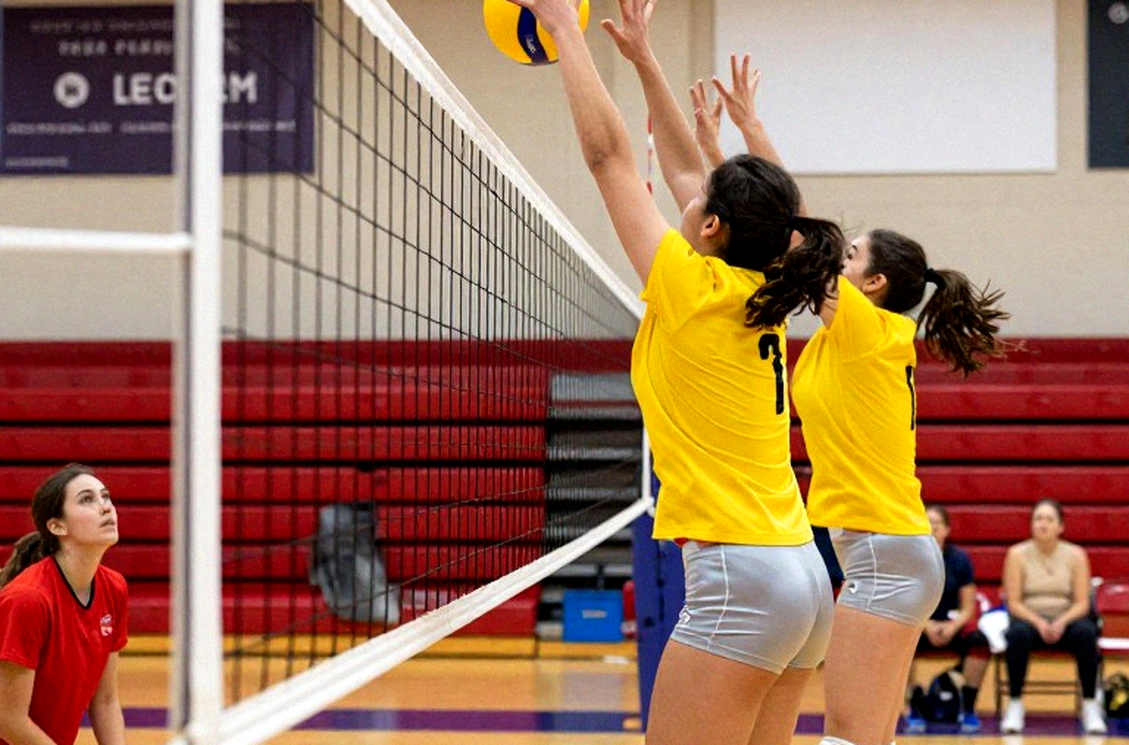
Anyanwu alone took 9 blocks. Nine blocks means she personally stopped Pitt's attack across multiple rallies. A block is not only a point; a block makes an opponent think. When an attacker knows a wall waits in front, she eases off, changes her angle, adds errors.
And SMU's block total is not accidental — this was their third straight match with 12 or more blocks. That means blocking is an established identity, a habit. When block-and-defense becomes an identity, it becomes repeatable against every opponent.
Look at the libero too. Harris took 20 digs. That is her second 20-dig match. She took 4 aces, tying her career high. A libero never wins a match alone, but 20 digs and 4 aces together mean serving that broke the opponent's reception and covering the backcourt behind that broken reception. This is serve-driven block-and-defense — not an attack model, but a model that wins by pressure.
I learned this from a final I coded by hand — blocks and digs are the points that never reach the highlights, but they settle the result.
Pitt's Single-Point Dependency: The Babcock Question
Now to the other side. Pitt's offense is largely Babcock-centric, 25 kills. No second scorer's number comes close.
Here lies the tactical trap. When a top-tier team relies on one person, two kinds of risk appear. First, it will beat weak blocking teams but stall against strong ones — because a good coach will load the block at that one point. Second, long sets bring fatigue, and fatigue falls heaviest on a single attacker.
Pitt's own self-scouting is the most revealing part. After the match, Babcock said the team had not yet met a high standard in matches, and that 'SMU saw that and took advantage.' That sentence is big. It does not call the loss a talent gap — it says a gap exists between practice form and match form, and the opponent scouted and exploited it.
Coach Fisher's message also stands out — he said the team 'needed to experience those emotions.' That sentence reframes a defeat as a chapter of development. It is not panic; it is learning. This is how an experienced coach absorbs the shock of a 58-match fortress falling.
But whatever the message, the scouting file is now open in opponents' hands. Every ACC coach now knows — to beat Pitt, leave Babcock alone and squeeze the rest.
38-36: A Test of Patience
The tactical hinge of this match is the third set, 38-36.
Such a long set is ultimately decided by side-out stability and crunch-point execution under fatigue. Pitt took the first set; then SMU won that marathon set and turned the match's momentum. In a set like that, no new tactic wins — what wins is who errs less and who holds rotation even while tired.
There is practical proof here. In such a long set, fatigue arrives for everyone. The deeper team feels less pressure on its pins. SMU's five-attacker depth pays off here — if one is tired, the ball goes to another, and the system does not break. For Pitt, the ball keeps returning to one person, and the pressure piles on.
In Sri Lanka I was the only one writing down what the scoreboard missed. There I learned that a long set is never a game of luck; it is a silent test of bench depth.
Data Credibility: Where the Numbers Should Stop
A confession is needed here.
First, all data comes from a single match. One match's hitting percentage and block average cannot establish season form. Newsome's .519 is a career high, but it is one night's work. No season-long baseline is in the report, so these are point-in-time snapshots.
Second, the fact that the match came against the No. 2 team does not discount the data — it raises it. Middles hitting .447 against a top opponent means the number carries more weight.
Third, some career totals still need checking against official NCAA records — Babcock's 1,853 kills and 176 aces, Harris being 9 digs short of 1,000. These are data pending verification. I never write a career record without checking, because one wrong number makes a true story unbelievable.
Fourth, there is a timeline discrepancy. The report says the match was on a Wednesday and the rematch on 'Sunday, Oct. 11.' A calendar check puts Oct. 11 on a different weekday, and the year is nowhere stated. So the exact date should be treated as verifiable, not final.
I keep this discipline in Bangladesh too. The empty stadium taught me that payroll is also a form of attendance; and an unchecked number is a kind of empty stand.
The Contrarian Angle: Is This Really a Power Shift?
Now to the question beyond the scoreboard.
Pitt's 58-match home unbeaten run ending is a fine headline. But a headline is not a structure. Pitt is still 14-1, still a top-tier program, still a title contender. One defeat does not destroy an institution. So the story 'Pitt is finished' is wrong.
More importantly, if we call SMU's win a 'miracle,' we insult SMU's work. On the Sri Lanka semifinal run I once wrote — reaching the semifinal was not a miracle; it was a budget line with legs. The same holds for SMU. Four top-10 wins, a clear blocking identity, an active middle attack — these are not one night's frost; they are the yield of a coaching project.
But a caution exists here too. SMU's real test is not this match, but the rematch ahead. One night's elite performance and one season's identity are two different things. If the setter-middle connection holds, .400+ is sustainable, and it becomes a durable weapon. If not, it is a beautiful evening and nothing more.
There is another structural dimension I often raise — in the era of conference realignment, SMU entering the ACC and immediately leading is not sudden. It is the result of an institution's deliberate investment — scholarships, coaching, recruiting. And in the transfer-portal era, rises like this accelerate, because talent is mobile. Every transfer window is a culture arguing with a spreadsheet.
The Rematch Pressure: A Four-Day Calculation
Perhaps the biggest structural fact of this match sits outside it — the rematch is only four days later, on Oct. 11, at SMU, broadcast on ESPN.
Four days means compressed preparation for both teams. And here is a practical tactical truth — under short preparation, the team with the simpler, more robust plan holds the edge. Pitt must now change its distribution, build a second and third scorer. SMU needs nothing new; it must keep its own balance and block. Tactical simplicity favours SMU in this short window.
But a rematch means two different risks. SMU's risk is repeatability — can it reproduce this win? Pitt's risk is its concentration being caught again. And there is a psychological risk — losing to the same opponent twice in a row creates a narrative slide: the fortress fell, then fell again to the same team. The ESPN broadcast means this pressure plays out before a national audience.
Yet there is a reassuring side. Both Babcock and Fisher framed the loss as a learning event. Delivering such a steady message after a 58-match fortress breaks is not easy. It shows the team's internal culture is not swallowing the outside noise.
Takeaway
So what is the real lesson of this match?
First, the battle between balance and concentration in volleyball never ends. At the top level, a superstar can exist, but a title comes when the opponent's block cannot guess. SMU proved this.
Second, blocks and digs are the silent currency the scoreboard never fully shows. 12.5 vs 6 — that number does not reach the headline, but it settled the match.
Third, and most important — the Oct. 11 rematch is the real judge. If Pitt wins, the story becomes 'the champion responds.' If SMU wins again, the story becomes 'a power shift.' Right now we hold only one night's evidence, and one night is not a trend.
I know nobody in Bangladesh writes volleyball reports around these questions, because here nobody looks beyond the scoreboard. But that is exactly why it needs writing. The story of a home fortress falling is really the story of a system — who is deep, who is concentrated, and who understands the game through data.
The next set will tell us whether 38-36 was an isolated nightmare, or the first line of a new arithmetic.